


As Mercari continues to scale its Artificial Intelligence capabilities, we’ve had the opportunity to work closely with engineers, managers (both technical and non-technical), and leaders across the organization. One thing has become immediately clear: almost everyone has a strong opinion about how AI will change our world, or at least how it will change their work.
These perspectives are often deeply polarized. Some see AI as the most transformative shift since the internet. Others view it with skepticism or concern. Both reactions are understandable. What matters most, however, is how organizations learn to navigate these differing worldviews while continuing to build reliable, production-grade systems.
To make sense of these dynamics, one useful way to look at AI adoption inside organizations is through three broad cultural lenses: Optimists, Pessimists, and Realists. This framing isn’t meant to judge or rank perspectives. Instead, it helps leaders understand motivations, sources of friction, and how to channel disagreement productively.
Part I: Understanding the Three Cultures
The Optimists: The Force Multipliers
Optimists are often found among senior leadership and engineers who are directly building AI- and LLM-based products.
Their energy is infectious. Conversations with this group are often filled with statements like, “This is the biggest shift since the internet.” From their perspective, AI is a genuine force multiplier, work that once took weeks can now be done in days, sometimes hours. While this is an oversimplification, the underlying momentum is real.
What defines Optimists is not uniform motivation, but consistent enthusiasm. They are excited by faster product cycles, new technical possibilities, and step-changes in how businesses operate. In many organizations, they become champions of change, pushing teams to think bigger and move faster.
At the same time, optimism without intellectual humility can become a liability. Healthy ambition must be paired with rigorous questioning. The strongest Optimists are those who ask: What are we assuming? Where might this fail? What constraints are we not yet seeing? When enthusiasm is balanced with discipline, it becomes a powerful driver of progress.
The Pessimists: The Psychology of Resistance
Pessimism around AI adoption is common, and often misunderstood.
In many organizations, especially in roles built around established processes and well-defined frameworks, AI introduces real uncertainty. Engineers working on maintenance, support systems, or SOP-driven workflows may worry about how their expertise will be valued in a world where automation accelerates rapidly. Managers may question how their roles evolve as tools become more capable.
Importantly, this resistance is rarely irrational. It is often rooted in concerns about professional identity, autonomy, and long-term relevance.
People in this group have built deep expertise by mastering edge cases and reliability. When AI enters the picture, it can feel like the very foundation of that expertise is being commoditized. Psychologically, this is a form of status threat, and it deserves to be acknowledged, not dismissed.
The Realists: The Foundation of Sustainable AI
Then there is the group we often rely on the most: the Realists.
These are the engineers and leaders working day-to-day with LLMs, retrieval-augmented generation, agentic workflows, and fine-tuned systems. They treat AI as what it is, a powerful tool, not a magic solution and not an existential threat.
This mindset aligns closely with Mercari’s engineering culture. Across teams, there is a shared awareness of both the potential and the current limitations of AI. Ideas are encouraged, but unrealistic assumptions are challenged early. Proof-of-concept success is clearly distinguished from production reliability.
Realists understand the difference between something that demos well and something that survives real-world complexity. They have seen elegant architectures fail under scale, latency constraints, or multi-system interactions. Their pragmatism is what enables sustainable innovation.
What this group needs most is not motivation, but enablement: clear goals, reduced bureaucracy, trust, and the authority to make technical decisions. Given that environment, they self-motivate.
Part II: Where the Cultures Clash
Optimists vs. Realists: Vision Meets Pragmatism
A common tension arises when Optimists propose ambitious AI initiatives on aggressive timelines, while Realists highlight the trade-offs required to meet them.
Many organizations fail here by defaulting to top-down mandates, overriding technical concerns in favor of speed. The result is often brittle systems and disengaged teams.
When managed well, however, this tension produces better decisions. Organizations that successfully combine vision with pragmatism consistently outperform those dominated by either perspective alone.
This requires collaborative conflict management:
- Optimists setting ambitious goals while respecting constraints
- Realists remaining open to calculated risk-taking
- Leaders acting as translators between vision and execution

Optimists vs. Pessimists: Momentum Meets Caution
This clash plays out at the level of organizational identity.
If pessimism is dismissed, valuable concerns go underground. If optimism is suppressed, momentum stalls. Organizations that struggle with AI adoption are often not limited by technology, but by an inability to hold these tensions constructively.
Creating safe containers for disagreement is critical, spaces where ambition and caution can coexist without becoming personal or political. When skepticism is understood rather than labeled, it often evolves into responsible ownership.
Realists vs. Themselves: When Caution Becomes Inertia
Even pragmatism carries risk. Over time, justified caution can harden into institutional conservatism. Organizations become excellent at execution, but lose their capacity to explore.
The antidote is deliberate space for experimentation, work that may never ship, but builds capability and keeps teams intellectually flexible.
Part III: Leading the Three-Culture Organization
So how do you actually lead an organization with these three cultures? Here’s what I’ve learned:
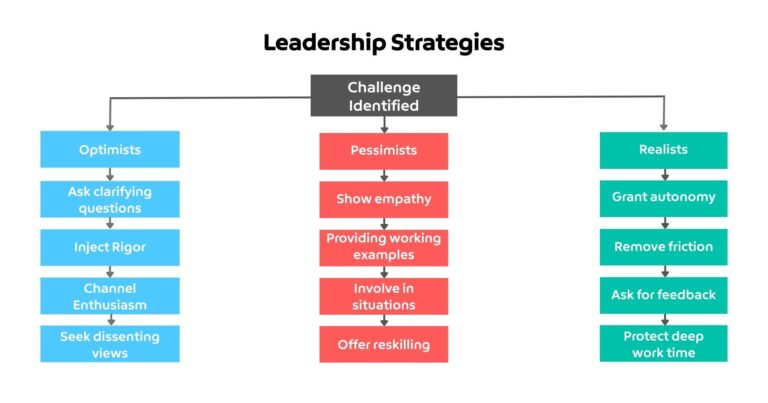
Effective AI leadership is less about choosing a side and more about orchestrating perspectives.
- Optimists need rigor without dampened enthusiasm
- Pessimists need safety, evidence, and pathways to growth
- Realists need autonomy, trust, and time for deep work
At Mercari, this balance is essential, not just for innovation, but for building systems that are reliable, ethical, and scalable.
Mercari India plays a key role in this journey, contributing deeply to both experimentation and production systems used across the global organization. The ability to navigate cultural and technical complexity across geographies is a core strength.

Final Thoughts
AI transformation is not primarily a technical challenge. It is a leadership and organizational one.
Most teams already have Optimists, Pessimists, and Realists. The question is not how to eliminate any group, but how to build an environment where each perspective makes the organization smarter, not slower.
When vision stretches us, skepticism hardens us, and pragmatism grounds us, without any one culture overpowering the others, we build AI systems that last.
If AI is forcing a new kind of leadership, which culture are you unintentionally amplifying, and what might that be costing you?